

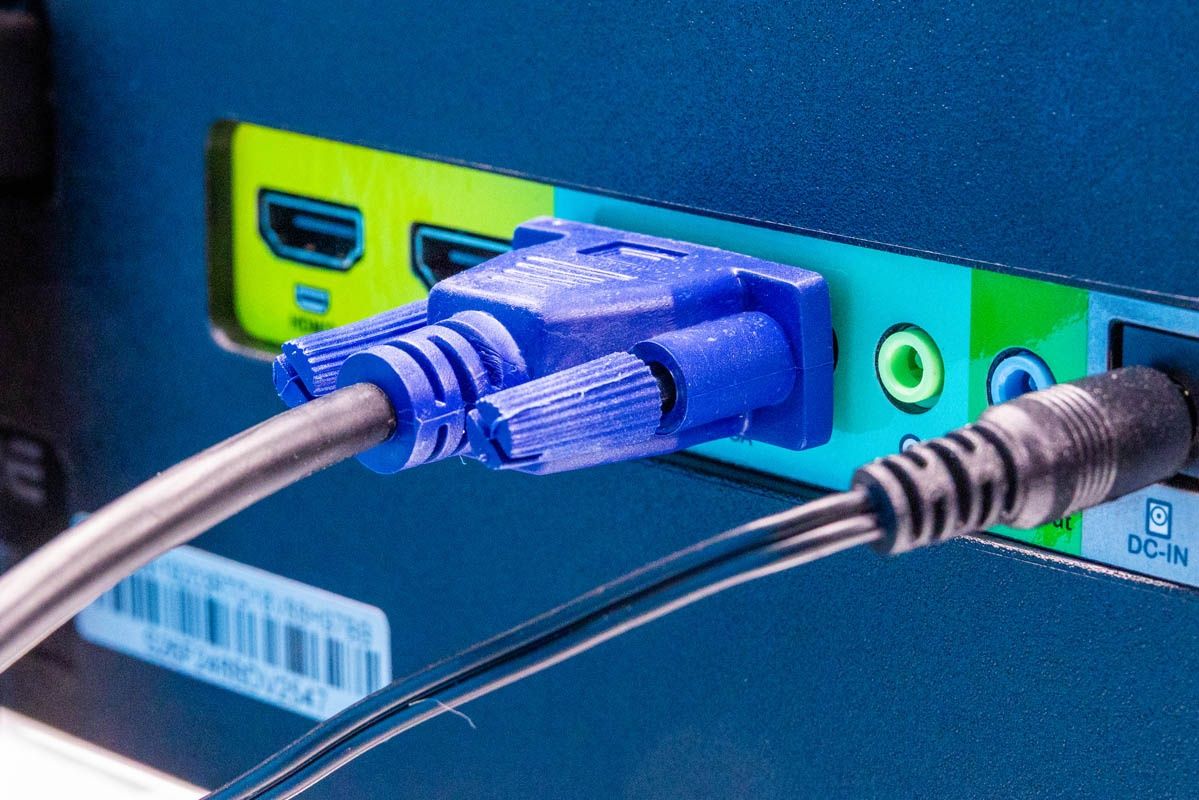
A Blast from the Past: The Curious Case of a 2026 Monitor with a VGA Port

📷 Image source: servethehome.com
An Unexpected Discovery in Modern Tech
Finding a legacy port on a brand-new display
In a tech landscape dominated by HDMI, DisplayPort, and USB-C, stumbling upon a brand-new monitor sporting a VGA port feels like uncovering a relic. Yet, that's precisely what happened during a recent hardware review. The Sceptre 24-inch Prime Monitor E248W-19203R, a model slated for 2026, includes this decades-old video connector, raising eyebrows and questions about its intended purpose in the modern era.
According to servethehome.com, the discovery was made while examining the monitor's input panel. The presence of the blue 15-pin D-sub connector, a staple of computing in the 1990s and early 2000s, stands in stark contrast to the monitor's otherwise contemporary 1920x1080 resolution and 100Hz refresh rate. It creates a peculiar technological juxtaposition that few would have anticipated seeing on a newly released product.
Dissecting the Sceptre E248W-19203R's Spec Sheet
Where old and new specifications converge
Beyond its anachronistic port, the monitor presents a mix of entry-level and modern features. The report from servethehome.com details a 24-inch IPS panel with a Full HD (1920x1080) resolution. The 100Hz refresh rate is a notable step up from the standard 60Hz, aiming to provide smoother motion in games and general desktop use, though it falls short of the 144Hz or higher commonly sought by enthusiasts.
The inclusion of VGA is paired with a single HDMI 1.4 port, which serves as the primary modern connection. This limited selection underscores the monitor's budget-oriented positioning. There's no mention of adaptive sync technologies like FreeSync or G-Sync, nor are there USB hubs or integrated speakers, focusing the package purely on visual output through a minimal set of inputs.
The Enduring, Niche Role of VGA
Why this analog standard refuses to die
The persistence of VGA is less about nostalgia and more about practical, albeit diminishing, necessity. In certain commercial, industrial, and educational environments, legacy systems are still in operation. Think of point-of-sale systems, factory floor monitoring stations, or older desktop computers in public libraries and schools. For IT departments in these settings, a monitor with a VGA port can be a lifeline, allowing them to extend the life of existing hardware without requiring costly adapters or system-wide upgrades.
Furthermore, the analog signal of VGA, while inferior in quality to digital standards, has a reputation for reliability over long cable runs in specific installed AV scenarios. Its inclusion on a budget monitor like the Sceptre E248W is a calculated business decision. It marginally increases the bill of materials while significantly broadening the potential market to include buyers who need to connect to very old PCs or specialized equipment, ensuring no customer is turned away for lack of a compatible port.
A Technical Look at the VGA Standard
Understanding the fundamentals of the legacy interface
To appreciate why VGA is so outdated, one must understand its technical foundation. Introduced by IBM in 1987, VGA (Video Graphics Array) is an analog video standard. It transmits red, green, blue, horizontal sync, and vertical sync signals over separate wires within the cable. This analog nature makes it susceptible to signal degradation, electrical interference, and noise over distance, which can manifest as image ghosting, color fringing, or a general softness.
The maximum theoretical resolution for standard VGA is 640x480, though extended versions pushed beyond that. The signal quality is highly dependent on the cable and the quality of the digital-to-analog converter in the source device and the analog-to-digital processing in the monitor. This stands in direct opposition to modern digital interfaces like HDMI and DisplayPort, which send discrete pixel data as zeros and ones, ensuring a perfect image arrives at the display provided the cable meets the specification.
The HDMI 1.4 Compromise
Analyzing the capabilities of the modern port on offer
While the VGA port grabs attention, the monitor's primary conduit is its HDMI 1.4 port. This version of HDMI, finalized in 2009, supports the monitor's 1920x1080 resolution at 100Hz, but it represents the lower tier of modern connectivity. According to the specifications noted by servethehome.com, the absence of a DisplayPort connection is a more significant limitation for a 100Hz panel than the presence of VGA.
HDMI 1.4 lacks support for advanced features like Variable Refresh Rate (VRR), which is now commonplace even in budget gaming monitors. Its bandwidth ceiling also means it cannot support higher resolutions or refresh rates should a user want to upgrade their PC in the future. This choice of input anchors the Sceptre E248W firmly as a basic, present-day display with one foot still in the past, designed for users with very specific, non-expandable needs.
Market Positioning and Target Audience
Who is this hybrid monitor actually for?
The Sceptre E248W-19203R isn't aimed at gamers seeking high frame rates, professionals needing color accuracy, or multimedia enthusiasts wanting sleek connectivity. Its profile suggests a monitor built for cost-sensitive bulk deployments or for individual users with a very old computer and a tight budget. The 100Hz refresh rate is a marketing-friendly bump over 60Hz, offering a slightly smoother experience for general Windows use or casual gaming, while the VGA port ensures universal compatibility.
This monitor likely finds its home in scenarios where reliability and compatibility trump cutting-edge performance. It's a tool, not an enthusiast's component. The decision to include VGA is a clear signal that Sceptre expects a portion of its buyers to value backward compatibility over future-proofing, catering to a segment of the market that major brands have largely abandoned.
The Broader Trend of Legacy Support
VGA's slow fade from the mainstream
The appearance of VGA on a 2026-dated monitor is an outlier, but it reflects a broader, gradual phase-out. Most mainstream motherboard and graphics card manufacturers began dropping VGA ports over a decade ago. Laptops, driven by the need for thinness, were among the first to abandon it. However, the ecosystem of legacy business and industrial hardware has a long tail, and display manufacturers like Sceptre are some of the last to cater to it.
This isn't entirely unique; even some modern business-class monitors from larger brands occasionally include a VGA port for that specific market need. The Sceptre E248W is notable because it combines this legacy feature with a consumer-oriented spec like 100Hz, creating a product that doesn't cleanly fit into either the strict 'legacy' or 'modern consumer' categories. It's a transitional product for a niche that is still transitioning.
Final Impressions on a Technological Anomaly
What the Sceptre E248W tells us about the market
The Sceptre 24-inch Prime Monitor E248W-19203R serves as a fascinating case study. It demonstrates that the evolution of technology is not a clean, uniform break but a staggered process with overlapping generations. While the tech world's attention is fixed on 8K, OLED, and 360Hz refresh rates, there remains a tangible, if shrinking, demand for products that bridge the gap between the old and the new.
As reported by servethehome.com, this monitor's existence is a pragmatic response to real-world IT challenges. It's a reminder that not every computing environment is a cutting-edge gaming rig or a creative workstation. For the user with an old office PC or a specialized system that only outputs VGA, this monitor provides a simple, plug-and-play solution. Its 2026 model year and VGA port together tell a story of a fragmented digital landscape, where the future arrives at different speeds for different people.
#Technology #VGA #Monitor #Hardware #LegacyTech


