

Beyond the Top: How ClickHouse Redefines Query Speed with Granule-Level Precision

📷 Image source: clickhouse.com
The Search for the Needle in the Data Haystack
The Fundamental Challenge of Top-N Queries
In the world of data analytics, one of the most common yet computationally expensive tasks is the Top-N query. This operation, which asks a database to find the highest or lowest ranked items—like the ten best-selling products or the five slowest server responses—seems straightforward. However, at petabyte scale, scanning entire tables to establish a global ranking is prohibitively slow and resource-intensive.
Traditional databases often struggle with this, forced to process vast amounts of irrelevant data to guarantee an accurate result. The core problem is one of efficiency: how can a system intelligently ignore, or 'skip', the vast majority of data that it knows cannot be part of the final answer? This is where the concept of data skipping becomes critical, transforming a brute-force scan into a targeted search.
ClickHouse's Architectural Answer: The Granule
The Building Block of Efficient Skipping
ClickHouse, an open-source column-oriented database management system, tackles this problem through its foundational storage unit: the granule. A granule is the smallest indivisible block of data that ClickHouse reads from disk during query processing. According to clickhouse.com, each granule typically contains 8192 rows of data. This granular structure is key to its performance.
Instead of viewing a table as a monolithic entity, ClickHouse sees it as an ordered sequence of these granules. For performance, data within each column file is stored in this granule order. This organization allows the system to maintain lightweight metadata about the minimum and maximum values for specific columns within each granule, creating a map of what data lives where without needing to inspect the raw contents during a query's initial planning phase.
The Mechanics of Granule-Level Skipping for Top-N
How the System Knows What to Ignore
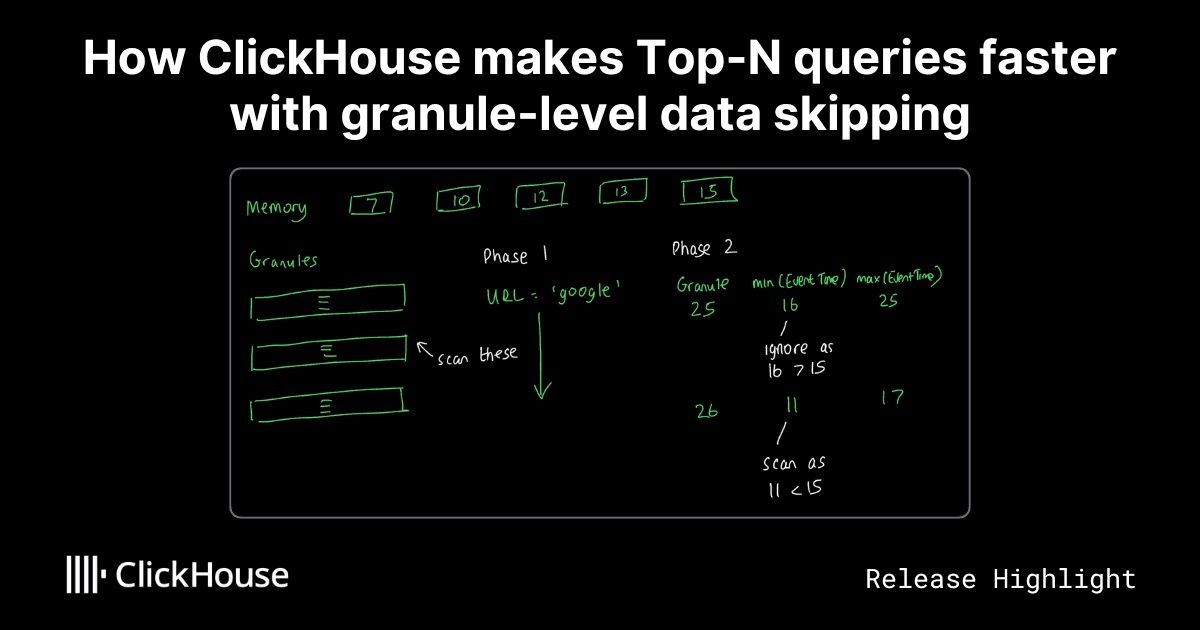
When a Top-N query, such as `SELECT * FROM hits ORDER BY Revenue DESC LIMIT 10`, is executed, ClickHouse employs a multi-stage filtering process. First, it consults the stored metadata (min/max values) for the ordering column (e.g., `Revenue`) in every granule. If a granule's maximum possible value cannot possibly compete for a spot in the final Top-N list, the entire granule is skipped from physical reading.
This process iteratively refines a threshold. As the query execution engine begins reading candidate granules and building a preliminary top list, it establishes a dynamic cutoff value. Any subsequent granule whose maximum value falls below this improving cutoff is immediately discarded. This creates a cascading efficiency gain, where the system becomes increasingly selective as it learns more about the data distribution during the query itself.
A Comparative Lens: Global vs. Granular Skipping
Why Finer Granularity Wins
Other databases or data formats implement data skipping at coarser levels, such as per file, per stripe, or per partition. While helpful, these larger blocks often contain a mix of high and low values, making it impossible to skip the entire block for a Top-N query. You still must read the entire file to find the few high-value rows inside.
ClickHouse's granule-level skipping is significantly more precise. Because granules are small (8192 rows), the min/max range within them is typically tight. If the granule's maximum is low, you can be highly confident that none of its 8192 rows will make the top ten. This precision dramatically reduces I/O operations—the primary bottleneck in analytical queries—by allowing the system to bypass large swathes of storage physically. The efficiency gain is not marginal; it can reduce the amount of data read by orders of magnitude.
The Role of Ordering: A Prerequisite for Performance
Why Data Layout is Not an Afterthought
The effectiveness of granule-level skipping is wholly dependent on how the data is physically ordered on disk. The skipping algorithm relies on the fact that data within a granule is sorted according to the table's `ORDER BY` key. This key is defined during table creation and is crucial for query performance, not just data organization.
If the query's ordering column aligns well with the table's sort key, the min/max ranges within granules are extremely selective. For instance, if a table is ordered by `timestamp` and the query seeks the top 10 latest records, skipping is nearly perfect. However, if the query orders by a column unrelated to the sort key, the value ranges within granules become wide and less useful for skipping. This underscores a core ClickHouse design principle: schema and sort order must be thoughtfully designed in tandem with anticipated query patterns.
Technical Deep Dive: The Algorithm in Action
From Metadata to Result Set
The process can be broken down into distinct algorithmic phases. Initially, the query planner gathers all granule metadata for the target column. It then performs a preliminary filter, quickly discarding granules whose maximum value is below a conservative initial threshold, often derived from sampling or known statistics. This first pass can eliminate a significant percentage of granules without any disk I/O.
Subsequently, the engine begins reading the remaining candidate granules in a prioritized order. As rows are read, it maintains an in-memory data structure—often a heap—containing the current top N candidates. The minimum value in this running 'top N' heap becomes the new, rising cutoff. Any granule not yet read whose maximum value is now below this updated cutoff is instantly removed from the processing queue. This interplay between in-memory computation and I/O scheduling is where the major performance leap occurs.
Real-World Impact and Performance Gains
Translating Theory into Latency Reduction
According to clickhouse.com, the impact of this optimization is profound for real-world workloads. In benchmarks and user reports, Top-N queries that once required full table scans or massive resource consumption now complete in a fraction of the time, often with sub-second latency on datasets spanning billions of rows. The reduction in disk read operations directly translates to lower cloud storage costs, reduced network traffic, and freed-up CPU cycles for other concurrent queries.
This efficiency is not just for simple queries. It extends to complex analytical operations that have a Top-N component, such as finding the top contributors to an error metric, the most active users in a time window, or the best-performing assets. By solving the core ranking problem efficiently, ClickHouse accelerates a whole class of business intelligence and monitoring queries that are fundamental to data-driven decision-making.
Limitations and Considerations
Understanding the Boundaries of the Optimization
While powerful, granule-level skipping is not a magic bullet. Its effectiveness diminishes if the data in the ordering column has poor cardinality or is uniformly distributed. If every granule has a similar, wide min/max range, few granules can be confidently skipped. The optimization also primarily benefits queries with a small `N` relative to the total dataset size. Searching for the top 10 out of a trillion rows is ideal; finding the top 10 million is less so.
Furthermore, the optimization is most effective when the query's `ORDER BY` and `LIMIT` clauses are used together in their standard form. Complex variations, window functions, or multiple ordering columns may not trigger the same optimized path. Database administrators must also be mindful of the initial table sort key design, as a poor choice can render this advanced skipping mechanism far less effective.
The Evolution of Data Skipping: A Brief Context
From Partitioning to Granules
Data skipping as a concept has evolved alongside database technology. Early methods relied entirely on manual partitioning, where data was split into separate directories based on date or category. While effective, this required deep foreknowledge and rigid data models. Later, formats like Apache Parquet introduced column-level statistics and row-group skipping, offering more flexibility.
ClickHouse's granule-level approach represents a further refinement, pushing the granularity of skipping down to a level that aligns with its vectorized execution engine's processing block size. This tight integration between storage layout, metadata, and query execution is a hallmark of modern analytical databases designed for scale. It reflects a shift from passive storage to intelligent, self-describing data formats that enable runtime optimizations.
Broader Implications for Data Engineering
Shifting Design Philosophies
The success of granule-level skipping influences broader data architecture practices. It encourages engineers to think more critically about the physical order of data at ingest time, prioritizing it as a first-class design parameter. The mantra becomes 'load data in the order you will query it.' This can reduce the need for secondary indexes or complex pre-aggregations for common ranking queries.
This capability also affects cost modeling for cloud data platforms. When queries read orders of magnitude less data, the pricing models based on bytes scanned become significantly more favorable. It empowers organizations to keep more granular, historical data online for interactive analysis, rather than archiving it to cold storage, because the cost of querying it remains low and predictable due to efficient skipping.
Future Trajectories and Adjacent Optimizations
What Lies Beyond Granule Skipping
The principles behind granule-level data skipping open doors to further optimizations. One area is adaptive granularity, where the system could dynamically adjust granule size based on data distribution for specific columns. Another is deeper integration with machine learning to predict value distributions and optimize skip thresholds before query execution begins.
Furthermore, the concept extends beyond simple min/max filters. Future iterations could incorporate Bloom filters or other probabilistic data structures at the granule level for `WHERE` clause predicates on non-sorted columns, enabling efficient skipping for a wider variety of query types. The ongoing development suggests a future where the database's metadata layer becomes increasingly rich and intelligent, acting as a highly accurate guide for the query execution engine.
Perspektif Pembaca
The drive for faster queries forces constant trade-offs. How should organizations balance the upfront cost of meticulously designing table sort keys and data ingestion pipelines against the long-term savings in query performance and cloud costs? Is the complexity of physical data layout a justified concern for application developers, or should it be entirely abstracted away by smarter databases?
We want to hear from you. Based on your experience with analytical workloads, which challenge is more prevalent: optimizing a few extremely critical, repetitive queries (where techniques like granule-skipping shine), or managing the unpredictable, ad-hoc query patterns from business analysts that require more general-purpose flexibility? Share your perspective on where engineering effort is best invested.
#ClickHouse #DataAnalytics #DatabasePerformance #QueryOptimization #BigData


