

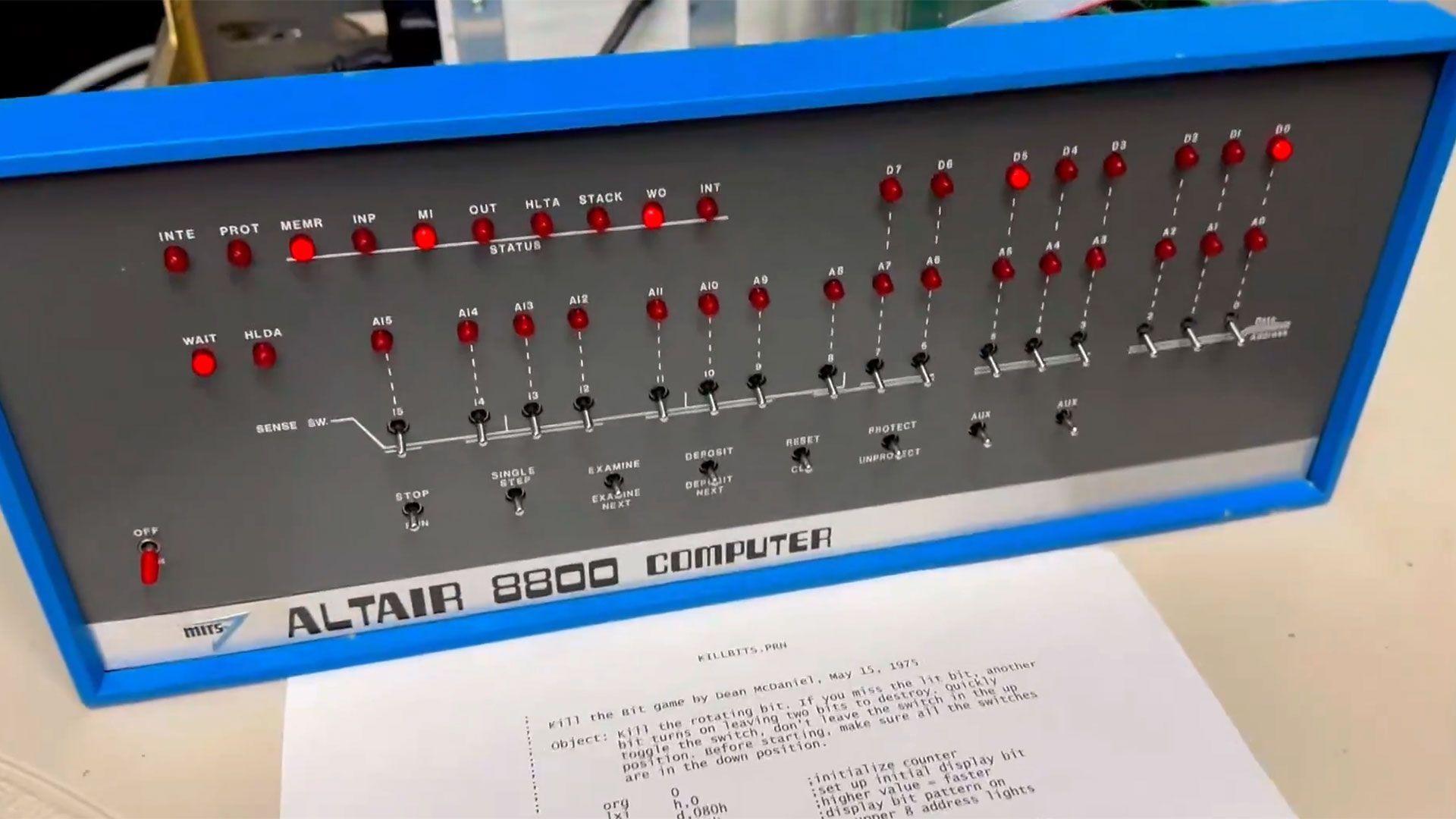
A 1974 Altair 8800, Misassembled for Decades, Finally Springs to Life in 2026

📷 Image source: cdn.mos.cms.futurecdn.net
A Historic Machine's Long-Awaited First Breath
After 52 years in silence, a pioneering personal computer finally runs its inaugural program.
In a remarkable feat of retro computing perseverance, a 1974 Altair 8800 computer, one of the machines that ignited the personal computer revolution, has finally executed its first program. According to tomshardware.com, this historic moment occurred in 2026, a full 52 years after the machine was originally assembled. The computer, powered by an Intel 8080 microprocessor, had never functioned due to critical assembly errors made during its initial construction in the mid-1970s.
The successful boot represents the culmination of a meticulous restoration project. The machine's owner, a dedicated enthusiast, discovered the non-functional computer and embarked on a mission to diagnose and correct the decades-old mistakes. The story is a poignant reminder of the fragile beginnings of the PC era, where hobbyists often worked from mail-order kits with minimal guidance, and a single wiring error could render an expensive investment inert.
Diagnosing a Half-Century-Old Fault
The journey from a silent box of components to a functioning relic.
The restoration began with a comprehensive diagnostic process. The report states that the owner, upon acquiring the machine, found it completely non-operational. Initial power-up attempts yielded no signs of life—no front panel lights, no response from the CPU. This pointed to fundamental flaws rather than simple component degradation.
Systematic troubleshooting led to the discovery of multiple, significant assembly errors. According to the findings detailed by tomshardware.com, these were not minor issues but fundamental mistakes in how the machine was put together. The errors were severe enough to prevent any basic operation, meaning the computer had effectively been a static display piece since its creation. The diagnosis phase required deep knowledge of the Altair 8800's architecture and a methodical approach to reverse-engineering the builder's original, flawed work.
The Critical Wiring Errors Unveiled
How simple mistakes in a complex kit led to a 52-year delay.
So, what exactly was wrong? The investigation revealed that the core of the problem lay in the machine's wiring. The Altair 8800 was famously sold as a kit, requiring the purchaser to solder and assemble hundreds of components. In this specific unit, critical connections were either incorrect or entirely missing.
According to the technical analysis, the wiring for the front panel—the iconic bank of switches and lights used to program the machine—was erroneously connected. Furthermore, essential data and address lines on the system bus, the computer's internal highway for information, were improperly routed. These mistakes meant the Intel 8080 CPU could not communicate with the memory or input/output systems. It was a computer in form, but not in function, isolated by a few crucial millimeters of misplaced solder.
The Restoration: Patience and Precision
Correcting history one connection at a time.
Fixing a machine this old requires more than just technical skill; it demands respect for its historical integrity. The restorer carefully de-soldered the incorrect wires, referencing original MITS blueprints and schematics to identify the proper connections. Each correction was made with period-appropriate techniques and materials where possible, aiming to preserve the machine's authenticity.
The process was slow and deliberate. How do you approach a project where every component is a piece of computing history? The restorer had to ensure that the repairs did not damage the original, now-irreplaceable, circuit boards or chips. This wasn't a modern repair job with abundant spare parts; it was an archaeological dig where every action was permanent. The goal was not just to make it work, but to make it work as it was originally intended in 1974.
The Moment of Truth: Powering Up History
Witnessing the blink of lights that should have happened in 1974.
After the corrections were complete, the moment of testing arrived. Applying power to the repaired Altair 8800, the restorer watched the front panel. For the first time in its existence, the machine responded. The status lights illuminated, indicating the Intel 8080 CPU was alive and executing instructions.
The inaugural program run was a simple memory test or a small demonstration routine, typical for verifying a basic system's functionality. Seeing the front panel lights blink in sequence, controlled by code loaded via the switches, was the definitive proof of success. According to tomshardware.com, this simple program run in 2026 was what the original builder had aimed for but failed to achieve. The machine had finally fulfilled its purpose.
The Altair 8800's Place in Computing Lore
Why this machine's awakening matters beyond the technical fix.
The Altair 8800 is not just any old computer. Released by Micro Instrumentation and Telemetry Systems (MITS) in 1975, it is widely credited with sparking the microcomputer revolution. It was the machine that inspired a young Bill Gates and Paul Allen to write a BASIC interpreter, leading to the founding of Microsoft. For hobbyists in the mid-70s, it was the first affordable, build-it-yourself computer that offered real computing power.
This particular unit, from 1974, is an especially early example. Its malfunction and subsequent repair tell a parallel, hidden history of the era—one of frustration, error, and delayed potential. While successful Altairs launched companies and careers, this one sat dormant, a silent witness to the revolution happening around it. Its activation closes a historical loop, bringing a laggard into the fold of functioning history.
The Challenges of Preserving Digital Heritage
What does it take to keep the foundational hardware of the digital age alive?
This restoration highlights the growing field and significant challenges of computer preservation. Hardware from this era is increasingly fragile. Capacitors degrade, traces on circuit boards corrode, and the knowledge of how these systems work becomes rarer. Fixing them is an act of conservation as complex as restoring a classic painting or a vintage automobile.
The work requires a unique blend of skills: historical research, electrical engineering, and often, custom fabrication of parts that haven't been made for 40 years. Enthusiasts and museums are engaged in a race against time to preserve these machines not just as static displays, but as operational artifacts. The successful repair of this Altair 8800 is a victory in that ongoing effort, proving that with enough dedication, these pivotal pieces of technology can still be made to speak.
A Legacy Finally Realized
From a kit in a box to a functional monument.
The story of this Altair 8800 is ultimately one of patience and redemption. A machine built with hope in the 1970s, destined for the scrapheap of failed projects, has been granted a second life. It now stands as a fully operational specimen of a critical point in technological history.
What does its first program run tell us? It underscores the passion that drove the early PC community—a passion that continues today in the retro computing scene. It also serves as a tangible link to a time when computing was physical, hands-on, and fraught with immediate, visible consequences for error. According to tomshardware.com, this machine's journey from erroneous assembly to successful operation is a unique chapter in the annals of computing history, finally written 52 years after the first page was turned.
#RetroComputing #Altair8800 #PCRevolution #TechRestoration #ComputerHistory


