

Unlocking Universal Security: How a New Open Standard is Transforming Cloud Threat Detection

📷 Image source: imgix.datadoghq.com
The Tower of Babel in Cloud Security
A Fragmented Landscape of Logs and Alerts
In the sprawling architecture of modern cloud computing, every service, application, and infrastructure component speaks its own language. Security teams are inundated with a cacophony of data formats—each cloud provider, SaaS platform, and on-premises system generates logs with unique structures and field names. According to datadoghq.com, this lack of a common schema forces analysts to write and maintain countless custom parsing rules, a process that is both time-consuming and prone to error.
This fragmentation creates a critical visibility gap. When a security incident occurs, precious minutes are lost translating disparate data into a coherent narrative. The challenge is not a lack of data but an overabundance of incompatible formats. This siloed reality stands in stark contrast to the interconnected nature of cloud-native environments, where a threat can traverse multiple services in seconds, leaving a trail of evidence written in different dialects.
Enter OCSF: A Common Language for Security
The Open Cybersecurity Schema Framework's Foundational Role
A concerted effort to solve this problem emerged with the Open Cybersecurity Schema Framework (OCSF). OCSF is an open-source project that provides a vendor-agnostic, extensible data schema for normalizing security telemetry. Its core purpose is to define a common set of event categories and a standardized dictionary of attribute names and types. For instance, an authentication event from AWS CloudTrail, a Microsoft Entra ID log, and an Okta event can all be mapped to the OCSF 'Authentication' event class.
The framework, as detailed by datadoghq.com, is not meant to replace raw logs but to act as a consistent translation layer built atop them. By adopting OCSF, security tools and teams can communicate using a shared vocabulary. This dramatically reduces the complexity of cross-correlating events from different sources. The development of OCSF represents a significant industry collaboration aimed at improving interoperability and reducing the operational burden of security data management.
The Datadog OCSF Processor: From Theory to Practice
Automating the Normalization Workflow
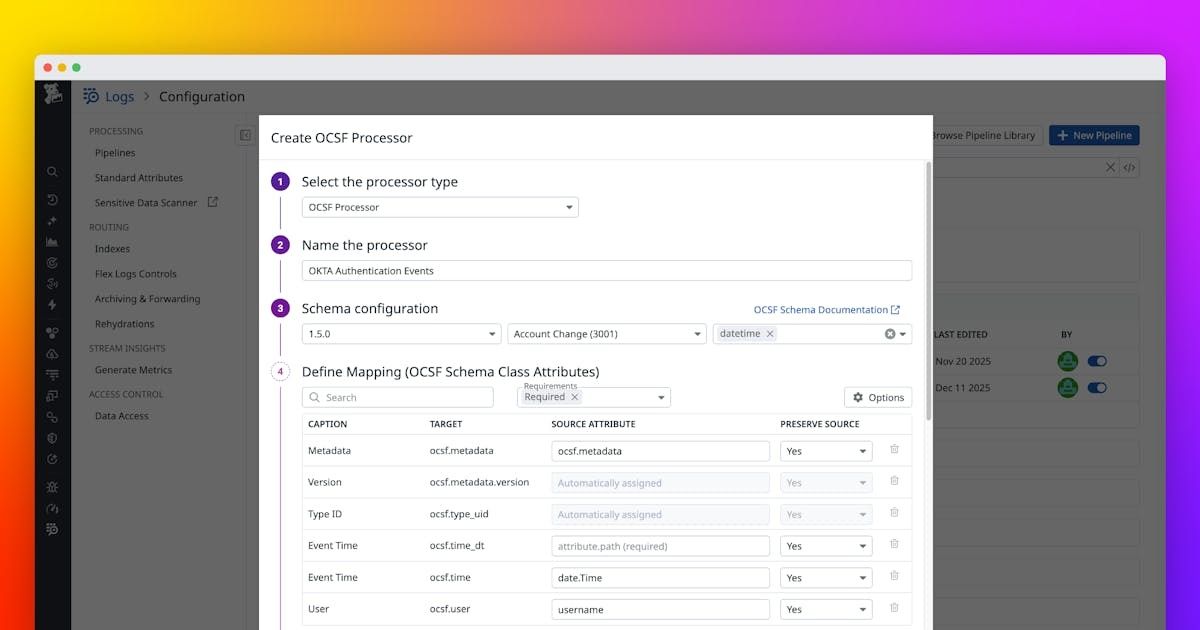
Datadog's implementation of this framework is the OCSF processor, a feature within its Cloud SIEM (Security Information and Event Management) product. The processor's function is to automatically ingest logs from hundreds of integrated sources and transform them into the standardized OCSF schema. According to datadoghq.com, this happens in real-time as logs flow into the platform. The processor handles the intricate mapping of source-specific fields—like `userIdentity.arn` from AWS or `userPrincipalName` from Azure—to the corresponding OCSF attributes, such as `actor.user.uid`.
This automation is the key to operationalizing the OCSF standard. Instead of security engineers manually writing parsers for every new data source, the processor applies pre-built, maintained mappings. This ensures that normalized data is immediately available for detection rules, investigations, and dashboards. The datadoghq.com article, published on 2025-12-30T00:00:00+00:00, positions this as a core capability for reducing 'time-to-value' in security monitoring, allowing teams to focus on threat detection rather than data engineering.
Anatomy of Normalization: How the Processor Works
A Technical Look at the Mapping Engine
The transformation process is multi-staged. First, the processor identifies the source of an incoming log, such as Google Cloud Audit Logs or a custom application log. It then selects the appropriate OCSF event class—like `Process Activity`, `Network Activity`, or `Finding`—that best represents the log's content. The most complex step is the field mapping, where the processor extracts values from the original log's nested JSON structure and places them into the defined OCSF attribute slots.
Crucially, the processor also enriches the data. It adds contextual metadata, classifying the event type, profile, and severity according to the OCSF model. For example, a failed login attempt is not just normalized; it is tagged as an `AUTHENTICATION` event of the `AUTHENTICATION_FAILURE` type with a severity of `MEDIUM`. This enriched, normalized output becomes the consistent foundation upon which all subsequent security analysis is built, from automated correlation to manual hunting.
The Immediate Impact on Security Operations
Streamlining Detection and Investigation
The most direct benefit of log normalization is the radical simplification of detection rule creation. Security engineers can write rules using the stable, predictable OCSF attribute names. A single rule designed to detect brute-force attacks can be applied universally to authentication events, regardless of whether they originate from AWS, Azure, or a SaaS application. According to datadoghq.com, this eliminates the need to create and update duplicate rules for each log source, reducing maintenance overhead and potential gaps in coverage.
During an investigation, analysts navigate a unified data model. Searching for a user's activity across the entire environment requires knowing only the OCSF attribute paths, not the idiosyncratic field names of a dozen different systems. This consistency accelerates mean time to respond (MTTR) by removing the cognitive load of constant translation. The investigation timeline presents a coherent story where events from disparate sources are logically aligned and directly comparable.
Beyond Detection: Enabling Proactive Security Posture
Unlocking Advanced Analytics and Benchmarking
Normalized data unlocks more advanced security capabilities. With all security events in a common format, performing aggregate analytics and trend analysis becomes straightforward. Teams can reliably measure metrics like 'authentication failures per user' or 'lateral movement attempts per subnet' across their entire hybrid estate. This data-driven approach supports more accurate risk assessments and helps prioritize remediation efforts based on a holistic view of activity.
Furthermore, OCSF facilitates internal and external benchmarking. Organizations can compare their security event profiles over time with greater accuracy because the data schema is consistent. While datadoghq.com does not provide specific statistics, the implication is that normalized data is a prerequisite for effective security posture management and compliance reporting. It transforms security data from a collection of isolated signals into a quantifiable, analyzable asset.
The Ripple Effect on Tool and Vendor Ecosystems
Driving Interoperability and Reducing Lock-in
The adoption of OCSF and processors that support it has broader implications for the security technology market. It promotes interoperability between different security tools. A detection rule or a dashboard built on OCSF-normalized data in one SIEM could, in theory, be more easily ported to another system that also understands OCSF. This reduces vendor lock-in and gives organizations more flexibility in assembling their security stack.
For technology vendors, building integrations that output OCSF-compliant data or accept it as input can become a competitive advantage. It lowers the barrier for their products to be adopted into existing security workflows. Over time, as support for OCSF grows, it could evolve into a foundational standard, similar to how TCP/IP underlies internet communication, enabling a more plug-and-play ecosystem for security technologies.
Navigating Limitations and Implementation Realities
Understanding the Boundaries of Normalization
While powerful, the OCSF processor is not a magic bullet. Its effectiveness is contingent on the quality and completeness of the source logs. If a critical piece of information is not logged by the source system, the processor cannot create it. The mappings are also based on known log sources; for highly custom or obscure log formats, some manual configuration or extension of the schema might still be necessary. Datadoghq.com explicitly notes that the processor is designed for known integrated sources.
Another consideration is schema evolution. OCSF itself is a living standard that will be updated. Processors and downstream detection rules must be maintained to track these updates. Organizations must also trust that the normalization mappings are accurate and comprehensive, as errors here could lead to false positives or, worse, false negatives in threat detection. The system's security is only as good as the fidelity of its data translation.
A Global Perspective on Security Standardization
OCSF in the Context of International Frameworks
The push for security data normalization is not occurring in a vacuum. It aligns with global trends in cybersecurity governance and best practice frameworks. Standards like the MITRE ATT&CK framework provide a taxonomy of adversary tactics and techniques, while others like NIST CSF provide risk management guidelines. OCSF complements these by addressing the foundational data layer. Reliable mapping of raw events to a standard schema is a prerequisite for effectively tagging events with MITRE ATT&CK techniques, for instance.
Internationally, regulators and organizations are grappling with similar data fragmentation challenges. A common schema can simplify cross-border incident reporting and collaboration between Computer Security Incident Response Teams (CSIRTs). While OCSF is an industry-led initiative, its success could inform or dovetail with future regulatory efforts aimed at standardizing security telemetry, much like accounting standards bring uniformity to financial reporting.
The Future Trajectory: Where Standardization Leads
Predicting the Next Evolution in Security Analytics
Widespread adoption of standards like OCSF paves the way for the next generation of security analytics: collaborative and intelligence-driven defense. With normalized data, anonymized threat intelligence about attack patterns can be shared between organizations with less friction, as the data describing the attacks is structurally identical. This could enhance collective defense mechanisms, allowing the community to identify and respond to emerging threats more rapidly.
On the technological frontier, normalized data is ideal fuel for machine learning (ML) models. Training ML algorithms for anomaly detection is significantly more effective on consistent, well-structured datasets. The OCSF processor, by creating this clean data foundation, enables more sophisticated AI-driven security applications that can identify subtle, complex attack patterns that would elude traditional rule-based detection. The long-term vision is a security ecosystem where data flows seamlessly and intelligently between tools, teams, and organizations.
Perspektif Pembaca
The move towards open standards like OCSF represents a significant shift in how the industry approaches security tooling. While the technical benefits for large enterprises with complex, multi-cloud environments are clear, the implications for smaller organizations or specific sectors like government or critical infrastructure may differ.
What has been your direct experience with security data fragmentation? For security practitioners: Have you encountered a situation where incompatible log formats directly slowed down an investigation or caused a detection gap? For those involved in procurement or strategy: How much weight does vendor support for open standards like OCSF carry when you evaluate new security tools, compared to features or cost?
#Cybersecurity #CloudSecurity #OCSF #DataStandardization #ThreatDetection


