

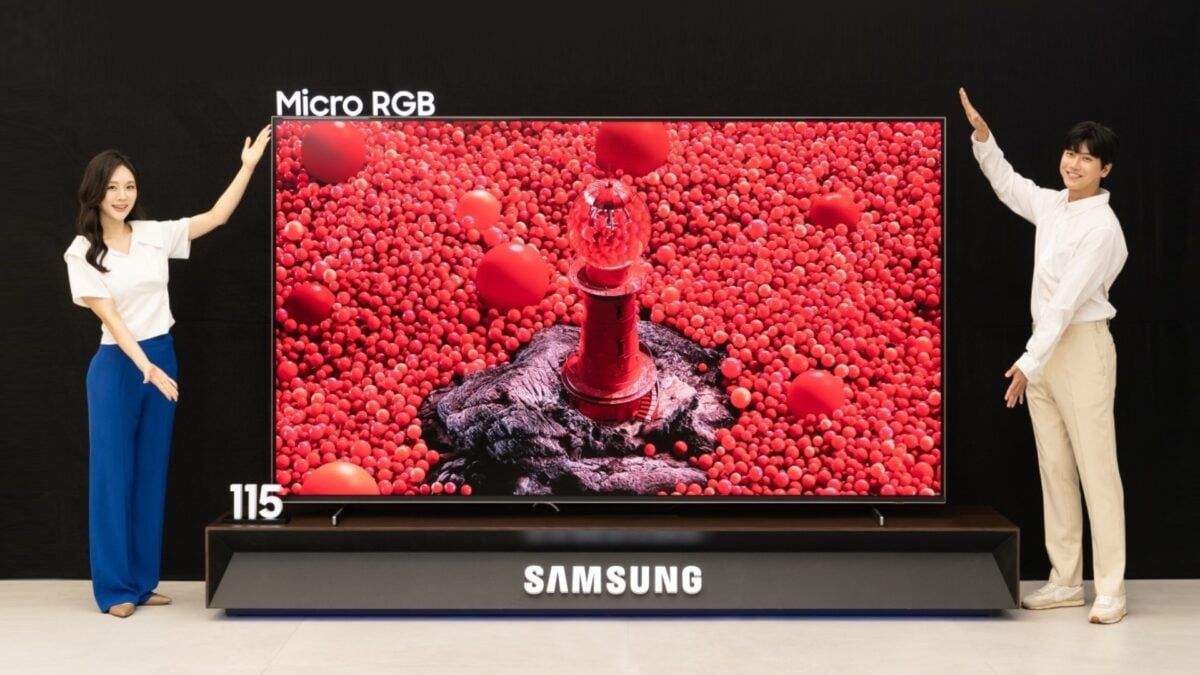
Samsung's 130-Inch Micro RGB TV: A Glimpse into the Future of Home Entertainment at CES 2026

📷 Image source: sammobile.com
A Colossal Debut at the World's Biggest Tech Show
Samsung prepares to unveil a television that redefines scale and picture technology
Samsung is set to make a monumental statement at the Consumer Electronics Show (CES) 2026 with the planned showcase of a massive 130-inch television utilizing Micro RGB display technology. According to a report from sammobile.com, dated 2025-12-31T13:17:30+00:00, this prototype will be one of the focal points of the company's presentation at the annual Las Vegas event, which serves as a global stage for launching groundbreaking consumer technology.
The sheer size of the display, measuring 330 centimeters diagonally, pushes the boundaries of what is currently considered a mainstream home television. While large-format displays exist for commercial and luxury home cinema markets, Samsung's intent to feature this model prominently at CES suggests a strategic move to normalize extreme screen sizes for high-end residential use. The choice of CES 2026 as the unveiling platform indicates Samsung views this not merely as a concept, but as a tangible vision for the near future of home entertainment.
Decoding Micro RGB: The Next Leap in Display Tech
Moving beyond QLED and OLED with a potentially superior pixel structure
The core technological claim of this television is its use of Micro RGB display technology. To understand its significance, one must look at the current landscape. Dominant technologies like QLED (Quantum-dot Light Emitting Diode) and OLED (Organic Light Emitting Diode) each have trade-offs in brightness, color volume, and risk of permanent image retention, known as burn-in. Micro RGB is presented as a potential advancement that could address these limitations.
While the sammobile.com report does not provide exhaustive technical specifications, Micro RGB technology typically refers to a display where each individual pixel comprises microscopic red, green, and blue sub-pixels that are self-emissive. This structure is fundamentally different from QLED, which uses a backlight, and is a refinement of existing micro-LED principles. The promise lies in achieving the perfect blacks and infinite contrast of OLED, but with significantly higher peak brightness and no organic materials that can degrade over time, thereby theoretically eliminating burn-in risk.
The Scale of Ambition: Why 130 Inches Matters
A deliberate push into the ultra-premium immersive experience segment
A 130-inch screen is not a casual upgrade; it is a deliberate architectural choice. For a 16:9 aspect ratio television, this translates to a screen roughly 287 centimeters wide and 161 centimeters tall. In a typical viewing environment, such a display would dominate a wall, offering a truly cinematic field of view without the seams of a multi-panel video wall. Samsung's move signals a belief that the market for immersive, room-dominant home theaters is ripe for technological disruption.
This size also presents immense engineering challenges, particularly for a technology like Micro RGB, which involves the precise placement of millions of microscopic LEDs. Manufacturing a panel of this scale with uniform brightness and color accuracy, and minimal chance of dead pixels, is a formidable task. Its showcase at CES 2026 will be a public test of Samsung's manufacturing prowess and quality control for next-generation displays at extreme dimensions.
The CES Stage: A History of Defining Moments
How past unveilings contextualize Samsung's 2026 play
CES has long been the launchpad for technologies that redefine product categories. Samsung itself has used the show to debut its first OLED TVs, The Frame lifestyle TVs, and massive wall-sized microLED displays for commercial use. The announcement of a 130-inch consumer-focused Micro RGB TV follows this tradition of using CES to set the agenda for the coming year—and in this case, perhaps the coming decade—in home entertainment.
Historically, technologies first shown as prohibitively expensive, large-scale prototypes at CES often trickle down to more accessible products within a few years. By establishing the 130-inch Micro RGB TV as a flagship vision, Samsung is likely laying the groundwork for future families of televisions that employ the same core technology in smaller, more affordable sizes. The CES reveal is as much about marketing a technological direction as it is about selling the specific product.
The Global Race for Display Supremacy
Samsung's move in the context of international competition
Samsung's planned showcase does not occur in a vacuum. The global display market is fiercely competitive, with South Korean, Chinese, and Japanese companies all vying for leadership in next-generation technologies. Chinese manufacturers have been aggressively advancing in LCD and OLED production, while other firms are also exploring micro-LED and related technologies. Samsung's 130-inch prototype is a high-profile bid to reclaim and solidify a position at the very pinnacle of display innovation.
This competition drives rapid iteration. A breakthrough in size or yield at one company pressures others to respond. For consumers worldwide, this rivalry accelerates the pace of innovation, potentially bringing advanced features to market faster. However, it also raises questions about standardization, as different companies may champion slightly different technological paths under similar names like 'Micro LED' or 'Micro RGB,' potentially confusing buyers.
Beyond the Screen: The Integration Challenge
The practical realities of installing and using a behemoth TV
Owning a television of this scale is more akin to installing a permanent home fixture than simply placing a piece of electronics on a stand. The logistical hurdles are significant. Transporting a 130-inch panel requires specialized handling and likely custom entryways into a home. Wall mounting demands a structurally sound wall, possibly with reinforced studs, and professional installation is not an option but a necessity. These factors immediately define the target customer: individuals with dedicated home cinema rooms and considerable budgets for both the product and its integration.
Furthermore, the user experience must evolve. Traditional TV interfaces and content upscaling algorithms are designed for screens up to 85 or 100 inches. At 130 inches, lower-resolution content may appear soft, and streaming bitrates may reveal compression artifacts more readily. Samsung would need to pair this display with a supremely powerful processor for real-time upscaling and optimization to ensure a wide range of content remains watchable on such a vast canvas.
The Content Conundrum: What to Watch on a 330cm Canvas
The need for native high-resolution sources to justify the technology
A display of this caliber and size demands content that can do it justice. While 4K content is now widespread, a 130-inch screen viewed from a typical home theater distance begins to approach the limits of what 4K resolution can provide for pixel-perfect clarity. The industry's slow move toward 8K broadcasting and streaming becomes more relevant here. However, as of the report's date, native 8K content remains exceptionally scarce, creating a gap between display capability and available media.
This highlights a recurring cycle in premium AV: hardware often advances ahead of content. The value proposition for early adopters of this TV would hinge on breathtaking upscaling of 4K and high-bitrate content, along with gaming from next-generation consoles or PCs capable of outputting high frame rates at high resolutions. The display could serve as a future-proof investment, awaiting the day when 8K or other high-density content streams become mainstream.
The Price of Pioneering: An Inevitable Luxury Good
Economic realities and market positioning for cutting-edge tech
The sammobile.com report does not mention a price, and for good reason. A first-of-its-kind 130-inch television using nascent Micro RGB technology will carry an astronomical price tag, likely placing it firmly in the realm of luxury goods for ultra-high-net-worth individuals and dedicated home cinema installers. Initial costs are driven by low manufacturing yields, expensive materials, and complex assembly processes for such a large, delicate panel.
This pricing strategy serves multiple purposes. It creates a 'halo effect' for Samsung's entire TV lineup, burnishing the brand's image as an innovator. It also allows the company to sell to early adopters who fund the refinement of the technology. Over time, as manufacturing processes improve and economies of scale are achieved, core elements of the Micro RGB technology can be adapted for smaller, more affordable models, democratizing the benefits learned from this flagship project.
Potential Impacts on Viewing Habits and Room Design
How extreme-scale TVs could influence our living spaces
The proliferation of televisions pushing beyond 100 inches could have subtle but meaningful impacts on interior design and media consumption. The traditional living room layout, with a TV as one element among many, may give way in premium segments to designs where the display is the central, dominant architectural feature. Furniture placement, lighting, and acoustics would all be planned around the screen. This shift further blurs the line between a dedicated home theater and a multipurpose living space.
From a consumption standpoint, such an immersive screen prioritizes long-form, high-quality content—movies, prestige TV series, and major sporting events. It may discourage casual, background viewing, instead encouraging more intentional 'event' viewing sessions. This aligns with content creators' push for cinematic television experiences but could also accentuate the digital divide in home entertainment, creating a stark contrast between basic and ultra-immersive viewing setups.
Risks, Limitations, and Unanswered Questions
Acknowledging the uncertainties surrounding a pre-release prototype
While the announcement generates excitement, several key uncertainties remain, as is typical for a product yet to be publicly demonstrated. The sammobile.com report is based on planned showcase information, and final specifications, performance metrics, and even the commercial availability timeline could differ. Key technical details such as peak brightness, color gamut coverage, refresh rate capabilities for gaming, and the specific pixel pitch of the Micro RGB array are not provided, leaving a incomplete picture of its performance relative to existing top-tier OLEDs or QLEDs.
Furthermore, the long-term reliability of such a large, complex panel is an open question. While Micro RGB technology theoretically eliminates burn-in, other failure modes for millions of microscopic LEDs over a vast area are untested in consumer environments. Warranty terms and service logistics for a product of this nature would be critical considerations for any potential buyer, areas where the current report offers no insight.
Perspektif Pembaca
The pursuit of ever-larger, more immersive displays raises fundamental questions about the role of technology in our personal spaces. Is the ultimate goal of home entertainment complete sensory immersion, where the screen fills our field of vision? Or does there come a point of diminishing returns, where size and technical specs overshadow content and shared experience?
We want to hear your perspective. If budget and space were no object, what would be the single most important factor for you in designing your ideal home viewing setup? Is it raw screen size, absolute picture quality (like perfect blacks and brightness), seamless integration with smart home ecosystems, or something else entirely? Share your vision for the future of the living room centerpiece.
#CES2026 #Samsung #MicroRGB #HomeEntertainment #FutureTech


