

Beyond the Noise: How AI Log Parsing is Transforming Digital Investigations

📷 Image source: imgix.datadoghq.com
The Unstructured Data Deluge
A Modern Investigation's First Hurdle
In the sprawling digital landscapes of modern enterprises, a silent flood occurs every second. It is not water, but data—specifically, log data. These are the continuous, automated records generated by applications, servers, networks, and devices, chronicling every transaction, error, and user interaction. For engineers and security teams, these logs are the primary evidence for troubleshooting a crashing application or investigating a security breach.
However, this evidence is notoriously messy. A single application might output logs in a dozen different formats. A snippet might read: `[ERROR 2025-12-01T14:22:01Z] API call failed for user_id=4421; code=503; upstream_svc=payment-processor`. Another, from a different system, could be: `WARN: 01-Dec-2025 14:22:03 UTC - Cache miss ratio exceeding 0.85`. This lack of standardization turns the initial phase of any investigation—simply understanding what happened—into a time-consuming puzzle of manual pattern matching and guesswork.
Parsing: The Essential Translator
From Text Strings to Actionable Fields
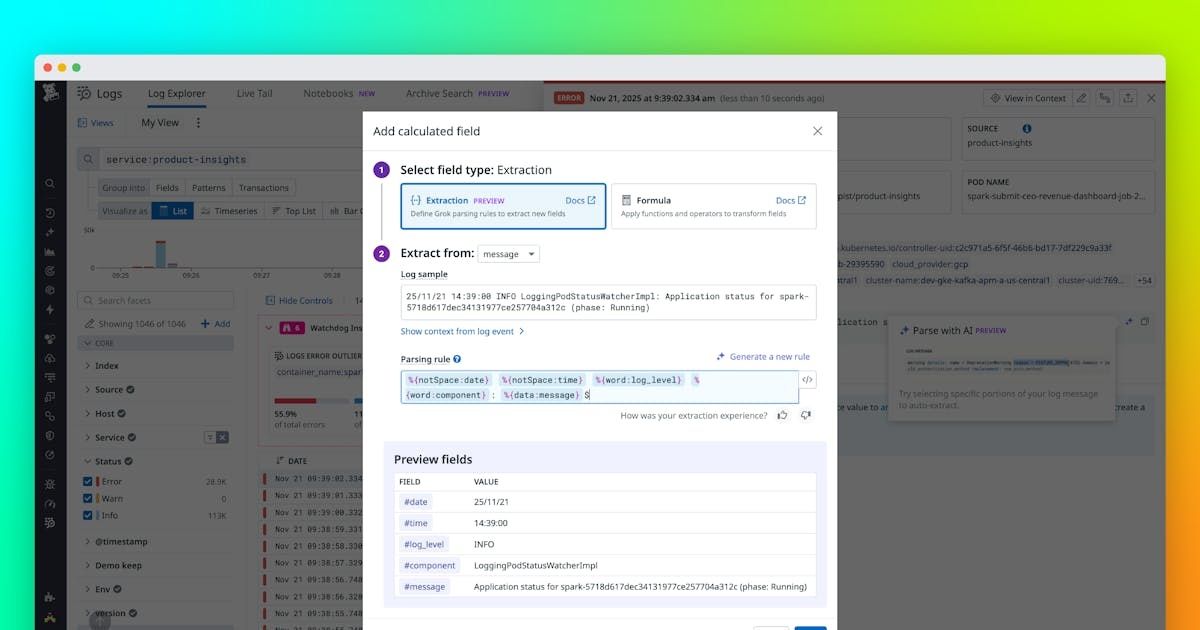
The critical bridge between raw log lines and human understanding is a process called parsing. Parsing is the act of ingesting a string of text and extracting structured, named fields from it. In the example `code=503`, a parser would identify '503' and assign it to a field clearly labeled 'error_code' or 'http_status'. This transformation is what allows teams to search, filter, and aggregate logs efficiently. Without it, finding all logs related to a specific user or error type becomes a futile exercise in scanning millions of lines of plain text.
Traditionally, parsing has relied on manually written rules, often using regular expressions (regex). A developer or operations engineer must anticipate every possible log format their systems might produce and craft a precise rule to catch it. This approach is brittle and labor-intensive. Every new software update or microservice added can introduce a novel log format, breaking existing parsers and creating blind spots in monitoring and security coverage. The maintenance overhead is substantial, as noted in analyses from platforms like datadoghq.com.
The AI-Powered Paradigm Shift
Moving from Manual Rules to Learned Patterns
The emerging solution to this scaling problem is artificial intelligence (AI)-powered log parsing. Instead of requiring humans to write and maintain countless rules, these systems use machine learning models to automatically discover patterns and infer structure from the logs themselves. The core idea is that the models learn the 'language' of an organization's logs—their common templates, variable placements, and delimiters—by processing vast volumes of historical data.
This represents a fundamental shift from a deterministic, rule-based system to a probabilistic, learning-based one. The AI model does not execute a pre-written instruction like "find digits after 'code='". Instead, it analyzes the contextual relationships between words, symbols, and values across millions of log lines to build an internal model of what constitutes a timestamp, an IP address, an error level, or a transaction ID. According to datadoghq.com's 2025-12-01 publication, this approach can automatically parse a significant majority of log formats without any human configuration, dramatically accelerating the initial data preparation phase of an investigation.
How the AI Model Understands Logs
A Peek into the Mechanistic Black Box
While the full technical depth of these models is complex, the general mechanism involves natural language processing (NLP) techniques adapted for structured text. The model treats a log line not as a random string, but as a sequence of tokens (words, numbers, punctuation). It is trained to recognize that certain token patterns are stable (like the word 'ERROR' or the string 'user_id=') while others are variable (the actual numeric ID or timestamp).
Through this training, the model learns to separate the static 'template' of a log message from the dynamic 'variables'. For instance, it might deduce that the template is `[ERROR
The Tangible Impact on Incident Response
Shaving Critical Minutes and Hours
The most direct impact of AI-powered parsing is on the speed and efficacy of incident response. In a scenario where a critical payment service fails, every minute of downtime translates to lost revenue and eroding customer trust. With traditional parsing, an engineer might first spend valuable time discovering that logs from a newly deployed service are not being parsed correctly, then writing a new rule, and only then beginning the actual analysis of the error's root cause.
With AI-assisted parsing, the logs from the new service are likely structured automatically from the moment they appear. The investigation can begin immediately. Engineers can quickly filter for high-error rates, correlate failures with specific user segments or upstream dependencies, and visualize the problem's scope. This reduction in 'time-to-understanding' is a critical metric in modern DevOps and security operations, turning what was often a lengthy data-wrangling phase into a near-instantaneous starting point for deep analysis.
Beyond Speed: Uncovering the Hidden Patterns
The Proactive Potential of Unified Data
The benefits extend beyond faster reaction times. Consistently and reliably parsed logs create a unified, queryable dataset of all system activity. This is a foundational requirement for more advanced, proactive observability and security practices. When every log event is broken down into its component fields, teams can perform complex aggregations and correlations that were previously impractical.
For example, a security analyst could query for all login events across every application—frontend, backend, database—where the source IP geolocation changed within an unusually short timeframe, regardless of each application's original log format. Similarly, a performance engineer could automatically correlate spikes in backend service latency with specific deployment versions or third-party API calls, even if the logs from each component used completely different naming conventions. This depth of analysis, powered by AI-driven data normalization, shifts teams from a reactive posture to one focused on trend identification and anomaly detection.
Navigating the Limitations and Risks
No Silver Bullet for Digital Complexity
Despite its promise, AI-powered log parsing is not a flawless solution. Its effectiveness is inherently tied to the quality and volume of the log data it was trained on. A model deployed in a completely novel environment with unique, proprietary log formats it has never encountered may struggle initially, requiring a period of learning or some manual guidance. The 'black box' nature of some complex models can also be a concern; if a parser incorrectly extracts a field, diagnosing why can be more challenging than debugging a straightforward regex rule.
Furthermore, the integration of AI into log management raises important questions about data privacy and governance. Logs often contain sensitive information: personal identifiers, internal system paths, or security configurations. Organizations must ensure that the AI training processes comply with data residency and privacy regulations, and that the models do not inadvertently memorize and leak sensitive patterns. The reliance on a centralized AI service also introduces a new point of potential operational dependency that must be managed.
A Global Perspective on Operational Intelligence
Standardization vs. Flexibility in International Contexts
The challenge of log parsing is universal, but its context varies globally. In regions with stringent data sovereignty laws, such as the European Union under GDPR, the physical and logical location where AI models process and learn from log data becomes a critical compliance issue. Companies may need on-premises or regionally-isolated AI parsing capabilities, which can influence the choice of technology provider.
Internationally, the push for open telemetry standards, like those from the OpenTelemetry project, represents a complementary approach to the parsing problem. These standards aim to create consistency at the source, encouraging developers to emit logs in a pre-structured format. However, the reality of legacy systems, diverse vendor products, and the fast pace of development means unstructured logs will persist for years. AI-powered parsing acts as a crucial adaptive layer, providing coherence across both modern standardized outputs and the vast installed base of legacy system logs, creating a common operational intelligence framework for global teams.
The Human Element in an Automated Workflow
Augmenting, Not Replacing, Engineer Expertise
A critical misconception is that AI parsing aims to fully automate and remove human expertise from the investigation loop. The opposite is true. The goal is to automate the tedious, repetitive task of data preparation—the 'digging'—to free up engineers and analysts for higher-value work. This human expertise is redirected towards interpreting the structured results, asking strategic questions, and making nuanced decisions that AI cannot.
The human role evolves from pattern writer to pattern validator and hypothesis tester. An engineer might review the fields the AI has extracted from a new log source, provide corrective feedback if needed (which further trains the model), and then use the now-structured data to test a complex theory about system failure. This symbiotic relationship amplifies human intelligence. The AI handles scale and pattern recognition at machine speed, while the human provides context, business understanding, and creative problem-solving, leading to more robust and insightful investigations.
The Future Trajectory: Predictive and Autonomous Operations
From Parsing the Past to Anticipating the Future
The logical evolution of intelligent log parsing is its integration into predictive and autonomous operational platforms. If an AI can understand the current and past state of a system through logs with high accuracy, it can begin to model normal behavior and identify subtle precursors to failure. The next step is moving from descriptive analytics ('what happened') to diagnostic ('why it happened') and ultimately to predictive ('what is likely to happen').
Future systems might use parsed log streams not just for post-incident investigation, but for real-time forecasting. They could alert teams that a specific sequence of warnings, parsed from disparate services, has a 90% historical correlation with a database failure within the next 30 minutes. This could trigger automated remediation scripts or scaled resource provisioning before users are affected. In this vision, AI-powered parsing becomes the foundational sensory layer for a more resilient, self-healing digital infrastructure, fundamentally changing the economics and experience of running complex software systems.
Perspektif Pembaca
The integration of AI into foundational IT processes like log management marks a significant shift in how we interact with complex systems. It promises greater efficiency but also introduces new dependencies and learning curves.
We'd like to hear your perspective. Based on your experience, what is the single biggest challenge your team faces when dealing with logs and system diagnostics today? Is it the volume of data, the variety of formats, the speed of analysis, or something else entirely? Share your viewpoint on where the primary friction lies in turning log data into actionable insight.
#AI #LogParsing #DigitalInvestigations #MachineLearning #DataAnalysis


