

Datadog's New Autoscaler Aims to Tame Unpredictable Kubernetes Costs

📷 Image source: imgix.datadoghq.com
The Elusive Goal of Efficient Kubernetes Scaling
Why managing cluster resources remains a complex challenge
For engineering teams running containerized applications, Kubernetes has become the de facto orchestration platform. Its power to manage and scale workloads is unparalleled. Yet, a persistent and costly problem often lurks beneath the surface: inefficient cluster resource utilization. It's a familiar scenario—engineers over-provision nodes as a safety buffer against traffic spikes, leading to clusters that are underutilized for significant portions of the day. The financial waste is substantial, but the risk of application downtime during sudden demand is a powerful deterrent against trimming that fat.
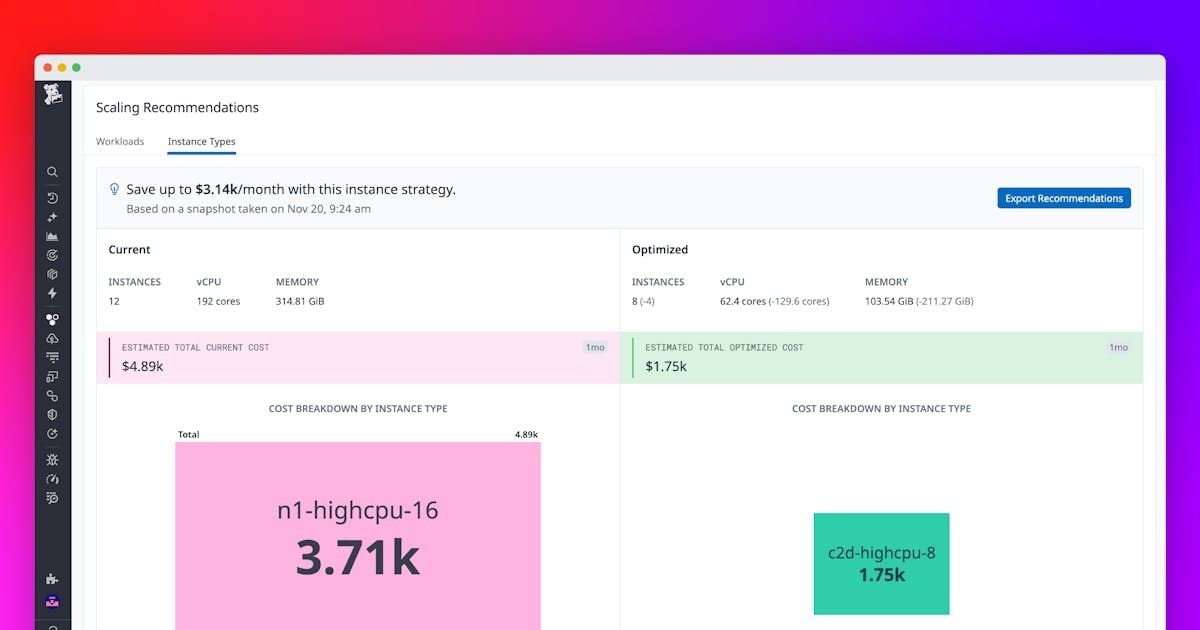
This is the core challenge Datadog's new Cluster Autoscaler aims to solve. Announced by datadoghq.com on December 2, 2025, the tool is designed to automatically right-size Kubernetes clusters in real-time, directly addressing the tension between performance reliability and cloud cost management. The promise is not just incremental savings, but a fundamental shift in how engineering and finance teams view infrastructure expenditure.
How Datadog Cluster Autoscaler Works: A Technical Breakdown
Moving beyond pod-based scaling to intelligent node management
Traditional horizontal pod autoscalers work within the confines of existing cluster nodes. If a pod needs more resources but no node has capacity, the pod will sit in a pending state, potentially causing performance degradation. The Datadog Cluster Autoscaler operates at the infrastructure layer above this, working in tandem with these pod scalers. According to datadoghq.com, its primary function is to proactively add nodes when workloads can't be scheduled due to insufficient resources and to safely remove nodes when they are underutilized.
The process is continuous and data-driven. The autoscaler monitors the cluster for any pods that cannot be scheduled. When it detects this condition, it communicates with the underlying cloud provider's API to provision a new, appropriately sized node into the cluster. Conversely, it regularly evaluates the resource usage of existing nodes. If a node's resources are mostly free and its pods can be feasibly redistributed to other nodes, the autoscaler will cordon and drain that node before removing it from the cluster entirely. This cycle creates a dynamic infrastructure that expands and contracts like breathing lungs.
The Critical Role of Observability Data
Why generic autoscaling often falls short
What distinguishes Datadog's approach, according to their announcement, is its deep integration with the platform's observability pipeline. A generic autoscaler might only consider simple metrics like CPU and memory reservation. The Datadog Cluster Autoscaler can incorporate a richer set of telemetry data, including custom metrics and even traces. This allows it to make more nuanced scaling decisions.
For instance, an application might experience a surge in database connections or external API calls that doesn't immediately spike CPU but will soon lead to latency or errors. By analyzing this broader dataset, the autoscaler can potentially anticipate the need for more resources before standard thresholds are breached. This context-aware scaling is crucial for maintaining smooth user experiences during complex, real-world events that don't fit simple metric patterns.
Navigating the Complexities of Node Disruption
Ensuring safe removal without impacting applications
Adding nodes is often the easier half of the equation. The real test of an autoscaler's sophistication is its ability to safely remove nodes without causing service disruption. A poorly implemented tool could evict critical pods, violate pod disruption budgets, or interrupt long-running batch jobs. The Datadog Cluster Autoscaler incorporates safeguards to mitigate these risks.
As outlined by datadoghq.com, it honors standard Kubernetes constructs like PodDisruptionBudgets (PDBs), which define the minimum number of available pods for an application. It won't drain a node if doing so would violate these budgets. Furthermore, the tool can be configured to respect node annotations that mark certain nodes as ineligible for removal, such as those hosting stateful applications or legacy systems with special requirements. This granular control prevents the automation from making reckless decisions that could jeopardize stability.
Cost Implications and the FinOps Connection
Translating resource efficiency directly to the bottom line
The financial impact of dynamic cluster scaling can be dramatic. Consider a development cluster that is only actively used for ten hours each weekday. With static provisioning, it runs at full cost for 168 hours a week, with utilization potentially below 20% for most of that time. An effective autoscaler could scale this cluster down to a minimal footprint during nights and weekends, potentially cutting its compute bill by half or more.
This aligns directly with the principles of FinOps, the operational practice of managing cloud costs. The Datadog Cluster Autoscaler provides a direct lever for engineering teams to implement cost optimization without manual intervention. The report from datadoghq.com positions the tool as a bridge between engineering autonomy and financial accountability, giving teams the power to scale aggressively while providing finance with predictable, usage-based cost reporting. It turns infrastructure from a fixed cost into a truly variable one.
Integration with the Broader Datadog Ecosystem
Autoscaling as part of a unified workflow
The autoscaler does not operate in a vacuum. Its value is amplified by its native place within the Datadog platform. Scaling events—node additions and removals—are logged as events in the Datadog event stream. This means they can be correlated with application performance metrics, error rates, and deployment markers. An engineer troubleshooting a latency spike can instantly see if it coincided with a cluster scale-down operation.
Furthermore, cost attribution becomes more straightforward. Teams can use Datadog's existing tag-based resource grouping to see the cloud costs associated with specific services, namespaces, or teams, and then observe how autoscaling behavior affects those costs over time. This creates a closed feedback loop where the impact of scaling decisions on both performance and budget is continuously visible, enabling iterative refinement of autoscaling policies.
Practical Considerations for Implementation
Key configuration points and potential pitfalls
Deploying any cluster autoscaler requires careful planning. Teams must define the parameters that govern its behavior: the cooldown period between scaling actions to prevent rapid oscillation, the thresholds for resource utilization that define an 'underutilized' node, and the specific cloud instance types it is permitted to launch. Configuring these incorrectly can lead to 'thrashing,' where the cluster repeatedly adds and removes nodes, or failure to scale when needed.
Another critical consideration is the mix of workloads. A cluster running a blend of latency-sensitive web services and long-running batch jobs presents a tricky balancing act. The autoscaler must be tuned to prioritize the stability of the web services, potentially keeping nodes online longer to accommodate the batch jobs' completion. According to the source material, successful implementation hinges on starting with conservative settings, closely monitoring the initial scaling actions, and gradually adjusting rules based on observed cluster behavior in production.
The Future of Autonomous Cloud Management
Where automated cost and performance optimization is headed
The introduction of the Datadog Cluster Autoscaler reflects a broader industry trend toward fully autonomous, self-healing infrastructure. The next logical evolution is predictive scaling, where machine learning models analyze historical traffic patterns—weekly cycles, marketing campaign impacts, seasonal trends—to provision resources before demand arrives. Imagine a cluster that begins scaling up thirty minutes before a planned product launch or a flash sale, based solely on learned behavior.
As datadoghq.com notes, the goal is to remove the human from the loop of routine, reactive scaling decisions, freeing engineers to focus on building features rather than managing capacity. However, this autonomy must be built on a foundation of trust, which is earned through transparency and control. Tools must provide clear explanations for their actions and robust mechanisms for human override. The journey toward truly intelligent infrastructure is not about eliminating engineers, but about empowering them with systems that handle the predictable so they can solve the novel.
#Kubernetes #CloudCosts #Datadog #Autoscaling #DevOps


