

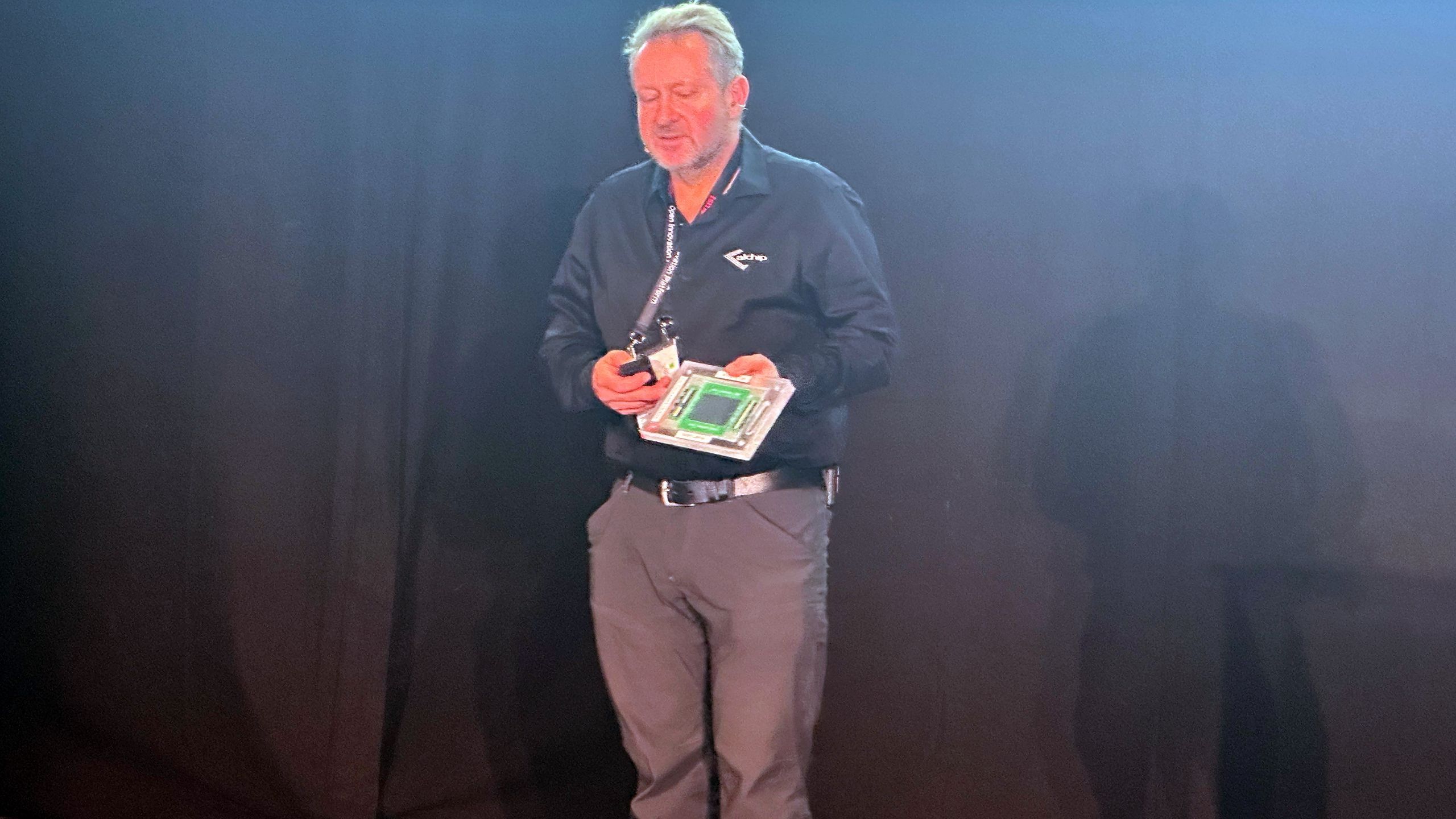
Silicon Photonics Breakthrough: Alchip and Ayar Labs Unveil First Optical I/O Solution for AI

📷 Image source: cdn.mos.cms.futurecdn.net
A Leap Beyond Copper
Optical I/O Emerges as the Critical Path for AI
The relentless demands of artificial intelligence are exposing the limits of traditional chip connectivity. As AI models grow exponentially, the copper wires that shuttle data between processors, memory, and storage are becoming a crippling bottleneck. They consume too much power, generate too much heat, and simply can't move data fast enough over longer distances.
This fundamental challenge is why the industry has been racing toward silicon photonics, a technology that uses light instead of electrical signals. Now, a significant milestone has been reached. According to a report from tomshardware.com, Alchip Technologies and Ayar Labs have unveiled what they call the industry's first optical connectivity solution built on TSMC's COUPE (Compact Universal Photonic Engine) technology. This demonstration, showcased on December 1, 2025, provides a tangible glimpse into a future where light, not electrons, connects the heart of next-generation AI systems.
The COUPE Engine: TSMC's Silicon Photonics Foundation
At the core of this breakthrough is TSMC's COUPE technology. COUPE is not a single chip, but rather a sophisticated co-packaging architecture. It allows a traditional electronic chip, like an AI accelerator or CPU, to be integrated side-by-side with a separate optical engine chiplet on the same carrier substrate or interposer.
This approach is critical. It means chip designers can leverage the best of both worlds: they can continue using TSMC's cutting-edge semiconductor processes (like N3 or N5) for the compute die, while incorporating specialized photonics for I/O. The optical engine handles the conversion of electrical signals to light and vice versa, managing high-speed data transmission through fiber optic cables. By separating the functions, each component can be optimized independently, improving yield and performance.
The Partnership: Alchip's Design Meets Ayar Labs' Light
The demonstration is a result of a strategic partnership combining distinct expertise. Alchip Technologies, a specialist in custom application-specific integrated circuit (ASIC) and system-on-chip (SoC) design, took the lead on the system-level integration and the design of the host compute chip.
Ayar Labs, a pioneer in chip-to-chip optical connectivity, supplied its patented TeraPHY optical I/O chiplets. These chiplets are designed to plug directly into the COUPE architecture. The collaboration shows that a full system solution—integrating a major foundry's packaging tech, a design house's integration skills, and a photonics innovator's core technology—is now viable. This moves silicon photonics from lab research and niche applications squarely into the mainstream roadmap for high-performance computing.
Performance Claims: Bandwidth, Power, and Reach
The Numbers Behind the Promise
So, what does this optical solution actually deliver? The report from tomshardware.com details specific performance metrics that underscore why this shift is necessary. The demonstrated link achieved a staggering bandwidth of 4 Terabits per second (Tb/s). To put that in perspective, it's the equivalent of transmitting over a hundred high-definition movies every single second.
More importantly, it did so with radically improved efficiency. The optical link consumed less than 5 picojoules per bit. In the world of massive AI clusters moving exabytes of data, this minuscule energy cost translates to monumental savings in total power consumption and heat dissipation. Furthermore, while copper struggles beyond a few meters, this optical solution is designed for reaches of up to 2 kilometers, fundamentally changing how data centers can be architected.
Solving the AI Cluster Bottleneck
Why does this matter for AI? Modern AI training involves thousands of GPUs or specialized accelerators working in concert. A significant portion of their time and energy is spent waiting for data or communicating results to each other over slow, power-hungry electrical networks. This communication overhead can drastically slow down training times for large language models and other complex AI systems.
An optical I/O fabric, as demonstrated by Alchip and Ayar Labs, promises to eliminate this bottleneck. With multi-terabit bandwidths and kilometer-scale reach, processors could communicate as if they were right next to each other, regardless of their physical placement in a data center rack or even across a campus. This enables more flexible, efficient, and vastly larger-scale AI clusters, potentially reducing the time to train frontier models from months to weeks.
The Path to Commercialization and Industry Impact
The demonstration is a proof-of-concept, but it points directly toward commercialization. By building on TSMC's COUPE, the partners are leveraging a packaging technology from the world's largest and most advanced foundry, which is a strong signal for industry adoption. TSMC's involvement means the infrastructure for volume manufacturing is being put in place.
This development puts significant pressure on other players in the AI and high-performance computing space. Companies like NVIDIA, AMD, and Intel, along with major hyperscalers such as Google, Amazon, and Microsoft, are all investing heavily in their own interconnect technologies. The public demonstration of a working, standards-based optical solution raises the bar, potentially accelerating the entire industry's timeline for adopting silicon photonics to sustain Moore's Law for data movement.
Technical Hurdles and the Road Ahead
Despite the impressive demo, challenges remain on the path to widespread deployment. Integrating optical components with silicon chips at scale introduces new complexities in testing, thermal management, and reliability. The cost of photonics chiplets and the supporting fiber optic infrastructure must also come down to be competitive with mature, albeit limited, electrical solutions.
Furthermore, ecosystem development is crucial. For optical I/O to become ubiquitous, it needs robust industry standards, design tools that seamlessly incorporate photonics, and a supply chain for the unique materials involved. The Alchip-Ayar Labs demo, validated on TSMC's platform, is a major step in proving that these hurdles can be overcome and that a viable ecosystem is forming.
A New Era for Chip Design
The unveiling by Alchip and Ayar Labs is more than just a new product; it signifies a paradigm shift in how we think about computing systems. For decades, the focus has been almost exclusively on transistor density and computational power. The interconnect was an afterthought. That era is ending.
As the report concludes, this optical connectivity solution paves the way for a future where data movement is no longer a constraint. It enables disaggregated data center architectures, where compute, memory, and storage can be pooled and connected over light. This breakthrough, detailed by tomshardware.com on December 1, 2025, marks a critical inflection point, proving that the silicon photonics future for AI is not just a theory—it's being built, packaged, and demonstrated today.
#SiliconPhotonics #AI #Semiconductors #OpticalIO #HighPerformanceComputing


