

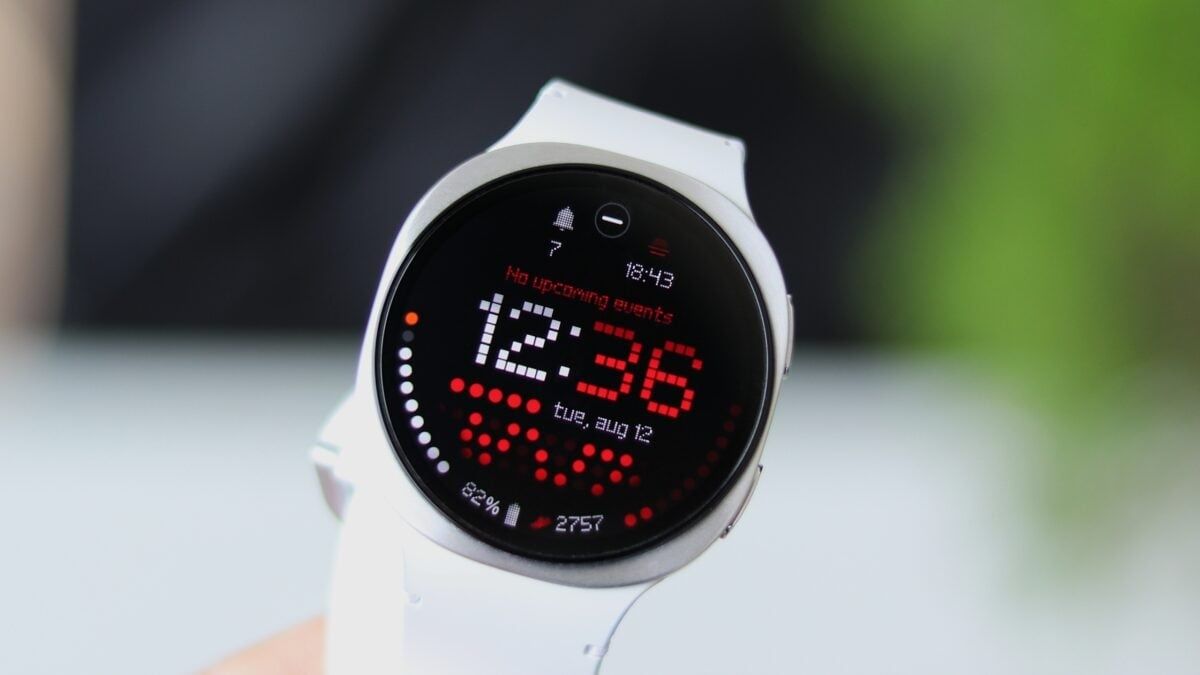
Galaxy Watch's Gemini AI Gets Major Conversation Upgrade: What Changes for Users

📷 Image source: sammobile.com
Introduction: The Frustration of Smartwatch AI Conversations
Smartwatch users have long faced a fundamental limitation when interacting with artificial intelligence assistants: the tiny screen forces conversations into disjointed fragments. Unlike smartphone or computer interfaces where you can see entire conversation histories, wearable devices typically display only the latest exchange, creating what developers call 'context amnesia' for both users and AI systems. This limitation becomes particularly problematic with advanced AI like Google's Gemini, which relies on conversation history to provide coherent, personalized responses.
According to sammobile.com, Samsung is addressing this core usability issue with a significant update to Gemini on Galaxy Watch devices. The September 24, 2025, report indicates that the upcoming enhancement will fundamentally change how users interact with AI on their wrists. Rather than treating each query as an isolated event, the improved system will maintain conversation context, making interactions feel more natural and substantially more useful for complex tasks that require multiple steps or follow-up questions.
The Technical Breakthrough: How Conversation Memory Works
From Isolated Queries to Continuous Dialogue
The technical implementation involves creating what engineers call a 'conversation buffer' that preserves context across multiple interactions. When you ask Gemini a follow-up question like 'What about tomorrow?' after inquiring about today's weather, the system now recognizes the connection instead of treating it as an entirely new request. This context preservation operates similarly to how modern chatbots function on larger screens but has been specifically optimized for the watch's limited display area and processing capabilities.
The system works by maintaining a short-term memory of recent exchanges while prioritizing the most relevant context clues. According to the technical details available, the watch version of Gemini can now reference approximately the last five to seven exchanges when formulating responses. This represents a significant improvement over the previous implementation, where each interaction essentially started from scratch, forcing users to repeat information or rephrase questions constantly throughout extended conversations.
User Experience Transformation: Before and After
From Repetitive to Fluid Interactions
Before this update, a typical weather inquiry might have required multiple precise commands: 'Show me today's weather,' followed by 'Show me tomorrow's weather,' and then 'What about Saturday?' Each query stood alone, forcing users to be explicitly specific and creating a stilted, robotic interaction pattern. The new system allows for natural language follow-ups like 'Will it be warmer then?' or 'What's the chance of rain?' without repeating the subject of the conversation, mirroring how human dialogues naturally evolve.
The improvement extends beyond simple convenience to actual functionality. Tasks that previously required smartphone intervention, such as multi-step calculations, travel planning, or complex scheduling, become feasible directly on the watch. Users can now ask Gemini to 'find flights to Tokyo next month under $800' and then naturally refine the search with 'Show me options with shorter layovers' or 'Any airlines with better legroom?' without restarting the entire query process each time.
Privacy and Data Handling Considerations
Where Your Conversations Are Stored and Processed
With enhanced conversation memory comes important privacy considerations. According to the available information, conversation data is processed following the same privacy protocols as other Gemini interactions. The context memory appears to be stored temporarily on the device itself rather than maintaining extensive histories on external servers, though complete technical specifications regarding data retention periods weren't explicitly detailed in the source material.
The localized processing approach helps address potential privacy concerns by minimizing how much conversation data transmits to cloud servers. However, users should remain aware that any AI assistant interaction typically involves some data sharing with the service provider. The report doesn't specify whether users will have controls over how much conversation history is preserved or options to manually clear the context buffer, leaving some implementation details uncertain until the update's full release.
Comparison with Competing Smartwatch AI Systems
How Galaxy Watch's Gemini Stacks Against Alternatives
Apple's Siri on WatchOS has maintained basic conversation context for several generations, though typically limited to very short-term memory spanning just two or three exchanges. The Gemini enhancement appears to push beyond this threshold, potentially giving Samsung's wearable platform an advantage in complex task handling. Meanwhile, other smartwatch platforms like Wear OS companions without advanced AI integration generally lack any meaningful conversation persistence, making direct comparisons difficult.
The improvement positions Galaxy Watch as potentially the most capable device for extended voice interactions among mainstream smartwatches. However, the source material doesn't provide specific benchmarking against competitors, leaving room for uncertainty about whether this implementation actually surpasses existing solutions or merely catches up to industry standards. What's clear is that for existing Galaxy Watch users, the upgrade represents a significant step forward in practical usability.
Implementation Timeline and Device Compatibility
When and Where Users Can Expect the Upgrade
According to sammobile.com's September 24, 2025, report, the enhancement is 'about to become' available, suggesting an imminent rollout rather than a distant future development. The phrasing implies the update could reach users within weeks or months rather than years, though exact release dates weren't specified. This timing aligns with typical software update cycles for Samsung's wearable platform, which often receives significant improvements alongside seasonal updates.
Device compatibility details remain somewhat uncertain, though historically, such core functionality improvements typically extend to recent Galaxy Watch models rather than being limited to the latest generation. Users with watches two to three years old can reasonably expect to receive the update, while much older models might not support the enhanced memory features due to hardware limitations. The report doesn't explicitly list compatible devices, leaving this important practical consideration partially unanswered.
Impact on Battery Life and Performance
The Computational Cost of Conversation Memory
Maintaining conversation context requires additional processing power and memory resources, raising legitimate questions about battery impact. The report doesn't provide specific data on how the enhancement affects power consumption, leaving users to wonder if the usability improvement comes with a trade-off in battery duration. Historically, software optimizations have often mitigated the resource demands of new features, but without technical specifications, the actual impact remains uncertain.
Modern smartwatch processors have become increasingly efficient at handling AI tasks, suggesting the additional overhead might be minimal. However, users with older watch models might experience more noticeable performance differences. The implementation likely involves clever optimization to minimize resource usage, such as only activating the conversation memory during active Gemini sessions rather than maintaining it continuously in the background throughout the day.
Practical Applications: Beyond Weather and Simple Queries
Real-World Use Cases Transformed by Context Awareness
The conversation memory enhancement unlocks practical applications that were previously cumbersome or impossible on a smartwatch. Fitness tracking becomes more intelligent—users can ask 'How does today's run compare to my average?' followed by 'What was my best time this month?' without re-specifying they're discussing running statistics. Cooking assistance transforms from simple timer setting to guided recipe following, with the ability to ask 'What's next?' after completing each step naturally.
Travel scenarios particularly benefit from the improvement. A tourist can ask for directions to a landmark, then naturally inquire about admission fees, hours of operation, and nearby restaurants without restarting each query. The continuous context makes the watch feel less like a simple command executor and more like a genuine conversational partner, significantly enhancing its utility in situations where pulling out a smartphone is inconvenient or impractical.
The Evolution of Wearable AI: From Novelty to Necessity
How Context Awareness Represents a Maturation Point
Wearable AI has evolved through distinct phases: initially as a novelty feature with limited practical use, then as a convenience for simple tasks, and now approaching genuine utility. The addition of conversation memory represents a significant maturation point, addressing what has been a fundamental limitation compared to smartphone and home assistant interactions. This evolution mirrors the broader development of AI assistants, which have progressively become more context-aware across all platforms.
The improvement suggests wearable AI is transitioning from being a scaled-down version of smartphone assistants to a platform with unique capabilities optimized for specific use cases. The always-accessible nature of watch-based AI, combined with more natural interaction patterns, could eventually make it the preferred interface for quick queries and task management, potentially reducing our dependency on constantly checking smartphones throughout the day.
Limitations and Future Development Possibilities
What the Current Enhancement Doesn't Solve
While significant, the conversation memory enhancement doesn't address all limitations of watch-based AI. The small screen still restricts visual responses, and voice interactions remain challenging in noisy environments or quiet settings. The update also doesn't appear to expand Gemini's core capabilities beyond what's available on other platforms—it primarily improves how existing features are accessed rather than adding new functionality.
Future developments might include even longer conversation memory, integration with more third-party applications, or specialized capabilities leveraging the watch's sensors. The natural progression would be toward predictive assistance, where the AI anticipates needs based on context patterns rather than simply responding to explicit queries. However, such advanced features would raise additional privacy considerations and likely require more sophisticated on-device processing capabilities.
Global Implications for Smartwatch Adoption
How Usability Improvements Influence Market Trends
Enhancements like conversation memory contribute to making smartwatches genuinely useful rather than merely fashionable or fitness-focused. As these devices become more capable of handling complex tasks independently, they may see increased adoption among professionals and older demographics who value practicality over novelty. This could accelerate the trend of smartwatches becoming essential tools rather than luxury accessories.
The improvement also has implications for global markets with different language patterns and communication styles. Languages that rely more heavily on context and implication rather than explicit statement might particularly benefit from conversation memory features. However, the report doesn't specify whether the enhancement has been optimized for regional linguistic variations or if it performs consistently across different languages and cultural communication patterns.
Technical Implementation Challenges Overcome
The Engineering Behind the Scenes
Implementing conversation memory on a device with limited processing power and battery capacity presents significant engineering challenges. Developers likely employed techniques like context compression, where only the most relevant information from previous exchanges is retained rather than storing entire conversations verbatim. The system probably also uses smart pruning to discard irrelevant context after certain thresholds or when topics clearly shift to unrelated subjects.
Another challenge involves balancing response time with context analysis. Adding conversation memory increases the computational work required for each query, potentially slowing down responses. The engineering team likely optimized this trade-off by implementing efficient context retrieval systems and prioritizing recent exchanges over older ones. These technical decisions, while invisible to users, fundamentally determine whether the feature feels seamless or sluggish in daily use.
User Adaptation and Learning Curve
How Interaction Patterns Will Change
Existing Galaxy Watch users will need to adapt their interaction patterns to fully benefit from the conversation memory feature. The natural tendency to treat each query as independent will gradually give way to more conversational approaches as users discover they can reference previous exchanges. This learning process mirrors how people adapted to smartphone assistants after years of using simpler voice command systems.
The most significant behavioral change will likely involve asking more complex, multi-part questions that leverage the context awareness. Instead of simple commands, users might begin treating Gemini more like a conversation partner, asking follow-up questions and refining requests naturally. This shift could ultimately make watch-based AI interactions feel less transactional and more collaborative, though the adaptation period might involve some initial frustration as users unlearn previous interaction habits.
Industry Context: The Arms Race in Wearable AI
Where Samsung's Move Fits in Competitive Landscape
Samsung's enhancement of Gemini on Galaxy Watch occurs within a broader industry trend of improving wearable AI capabilities. Apple continues refining Siri's contextual understanding, while Google develops its own wearable AI strategies for Pixel Watch. This competitive environment drives rapid innovation but also creates fragmentation, as each ecosystem develops its own approach to solving similar usability challenges.
The move reinforces Samsung's strategy of leveraging Google's AI technology while optimizing it for their hardware ecosystem. This partnership approach contrasts with Apple's fully integrated system and Google's first-party hardware efforts. Each strategy has advantages—Samsung benefits from Google's AI expertise while maintaining hardware differentiation, though this approach sometimes results in features arriving on different timelines across the Android wearable ecosystem.
Perspektif Pembaca
How has your experience with smartwatch AI assistants evolved over time? Have you found them increasingly useful for daily tasks, or do they remain more novelty than necessity in your wearable experience?
What specific situations would most benefit from improved conversation memory on your wrist? Would it change how you use your smartwatch during workouts, commuting, work tasks, or social situations?
#GalaxyWatch #GeminiAI #Smartwatch #Samsung #AIUpdate


